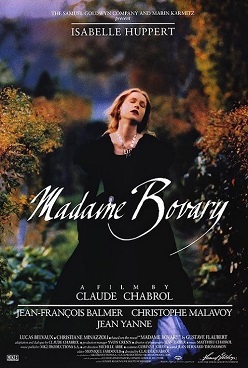
Claude Chabrol
2014
118 minutes
This has been a long time coming. You've never read this Flaubert novel, but you've been intrigued by it for a long time. You've read the Wikipedia summary several times, but it has never really stuck with you and all you really know going in are the basics and various references from pop culture about a bored housewife cheating on her husband and eventually killing herself in a dramatic fashion. There are several versions of this but you'll be watching the 1991 French version directed by Claude Chabrol while you're waiting endlessly for the bus to take you to and from the Farmers Market.
You've long been curious about this work of literature because of a board game you had as a kid. When you were a child you had an extremely elaborate solo board game called Ambush!, which was unusual since it was designed for a single player and ideal for an only child (which you were at that point). The board game simulated tactical squad level combat during WWII. It had a couple of very beautiful and detailed hexagonal maps with elevation marked on them and an elegant but complex and realistic set of rules regarding visibility and cover. But the real innovation was the "paragraph booklet" which allowed for what was essentially a WWII combat-themed Dungeons and Dragons game without a gamemaster. The paragraph booklet was a bit set up like a Choose Your Own Adventure book, obviously another interest of yours if you've made it this far into these pages. You would move your soldiers around the map and look up the locations they encountered and roll dice to determine whether they would encounter enemy soldiers or sniper fire or landmines, et cetera, during their turns. It was ingenious. It was like an early computer game implemented without a computer--all paper and dice.
Most entries in the paragraph book were standard meat-and-potatoes things. "Activate German sniper #61 in hex Q3 with initiative +1 for this turn", or "Conduct Activation Check (+2). If successful see Section 523". Some may ask for a perception check to see if the soldier notices they have stepped into a mine field. Some descriptions were more elaborate and interesting, describing the documents you were sent to find or giving additional information about hidden spots on the map. It was all cleverly done and must have been extremely labor-intensive.
As is common with computer programs, even analog ones, the designers decided to put in some "easter eggs" of sorts, which caught your eye as you were flipping through the book to see how it worked. They had a few absurd entries in the paragraph book that were unreachable by normal means. Some of them directly called out the player for cheating. But one in particular was an absurdist masterpiece:
499. [s6] Your soldier has entered a Flaubert novel. Having walked into the house's parlor, he now faces Emma Bovary. Her face, seen in profile, was so calm that it gave him no hint. It stood out against the light, framed in the oval of her bonnet, whose pale ribbons were like streaming reeds. Her eyes with their long curving lashes looked straight ahead: they were fully open, but seemed a little narrowed because of the blood that was pulsing gently under the fine skin of her cheekbones. The rosy flesh between her nostrils was all but transparent in the light. She was inclining her head to one side, and the pearly tips of her white teeth showed between her lips. "Is she laughing at me?" your soldier wonders.
This was your initial encounter with Emma Bovary, played here by Isabelle Huppert, and you are glad to finally meet some version of her on film.
After you watch this, you are going to chase it with a VeggieTales episode which came up while you were trying to decide which version to watch. That episode is called Madame Blueberry and it's a surprisingly accurate version of the story (except about plant-based foodstuffs), with a moral about not being too materialistic. It's pretty good as far as Veggie Tales stories go.
Time to choose something different: