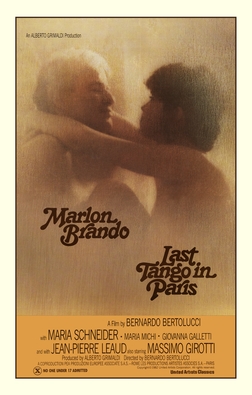
Bernardo Bertolucci
1972
129 minutes
This is the movie where disconsolate widower Marlon Brando buggers eighteen year old Maria Schneider with a stick of butter. It's one of those sad, horny 1970s films where that something like that can be the basis of the film. This central event made this film quite the salacious talk of the town and quite a draw for your primitive ancestors. The combination of the age difference between Brando and Schneider, the fact that Schneider was "barely legal", the buggery aspect of it, the non-consensuality of the buggery, the fact that the butter-buggery was sprung suddenly on the actress, and the knowledge that the actress herself was surprised and uncomfortable with this unscripted change that was foisted upon her all made this a very spicy scene for 1970s audiences and still for some modern audiences.
We are now certainly supposed to feel sad and uneasy about this scene, and doubly so knowing the actress was actually not really on board with the whole thing. Bertolucci himself said he surprised her with the scene because he wanted her reaction "as a girl, not as an actress". But this isn't really why we watch films, or at least not why you do. It breaks the social contract. You feel that movies, or at least non-documentary movies, should be a safe space where a viewer can know that at the end of the day everyone walks away okay with what happened on-set, regardless how intense the scene was. They know they're on camera. They're portraying emotions they agreed to portray. They own their performances.
There's enough misery and trauma in the real world, and with a trip to some of the seamier corners of the internet you can watch real people go through real trauma, sometimes in real time. You like war movies? Here's some actual combat footage. You're a gorehound? Forget horror movies. There are plenty of sites that can show you real people getting grievous and even fatal injuries that they're not going to walk away from.
Wikipedia helpfully points out that the rape is "simulated", at least in the sense that there was no actual penetration. But the tears and shame are real, which seemed to be part of the director's intent. This is the sort of scene that trigger warnings were made for, and it makes you feel kind of miserable watching it.
As a disconsolate widower yourself, your experiences don't make you very sympathetic to Brando's character. Everyone processes grief differently, but this depiction seems vulgar and grotesque and alien to you. It seems like a screenwriter's idea of how someone might process such a profound loss, poured through a sex funnel so that it becomes that sort of film. It seems artificial and weird and the widowhood aspect of Brando's character's motivations is off-putting in itself.
You try to imagine what it would be like if someone put a camera in your face at some of the most traumatic moments of your own life to capture your reaction as a "real person" and not an actor. It would probably be disappointing--an underreaction. There's a reason actors and actresses "paint for the back row", and it's a myth that trauma is in the moment. Even disregarding the ethics, it's stupid to capture the moment of birth of someone's trauma when the real pain is mostly in what happens later. And by that time the cameras have stopped rolling and no one cares.
On a somewhat brighter note, this film co-stars Jean-Pierre Léaud as Maria Schneider's character's hapless fiancé. He's not Antoine Doinel in this flick, of course, but he's a film director and kind of a schmuck. And you might as well imagine him as Antoine Doinel cluelessly doofusing around while his cheating girlfriend bangs another guy who ends up violently raping her. It's the kind of thing that would happen around a real-life Antoine Doinel. It's certainly a realistic outcome for a girlfriend who might put up with his failures and philandering awhile before searching for something better but failing to make an upgrade.
Time to choose something different: