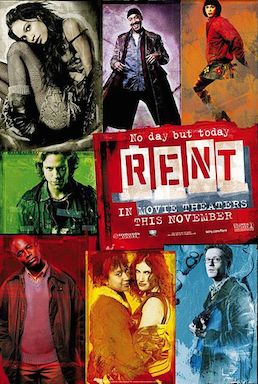
Chris Columbus
2005
135 minutes
You've spent more time at karaoke listening to people doing terrible renditions of "Seasons of Love" than you will ultimately spend watching this film for the first time. As a math person, you feel obligated to check the math on five hundred twenty-five thousand six hundred minutes. You have never properly internalized this number since, as a mathematician, it is something you can calculate on the fly if the need ever arises.
As an opera-lover, you are slightly charmed that someone decided to do a musical theater version of La Bohème, but that too is ultimately a bit distracting. You find yourself trying to map the principal characters of Rent onto the ones in La Bohème and then confusing yourself, awaiting references that never materialize. What's worse, you find some of the actual references to the music in the original confusing and off-putting. Using "Musetta's Waltz" in anything but an at least slightly comic sense is very jarring. It's like watching someone singing a serious aria to the tune of "Yakety Sax" from Benny Hill.
You buckle in and try to enjoy the musical. People start mooing for the performance artist and you're distracted again. Some of the spoiled, entitled artist stuff hits close to home. You alternate between finding things extremely funny, extremely identifiable, or extremely annoying, depending on the scene. The love-hate evens out in the end. You imagine your experience watching this leaves you with roughly the same affection or annoyance that an opera-deaf person with little exposure to performance artists and theater people would have upon seeing this.
You think fondly back on the performance artist you took to her first opera when you worked for the radio station. You had a plus-one along with your own free ticket. She was a classically trained singer and occasionally made operatic vocals part of her act. You initially can't remember if it was Tosca or Il Trovatore. Upon further reflection you recall it was Il Trovatore, since you remember how you both involuntary laughed out loud at the reveal at the end that the troubadour and the count were actually long lost brothers. In the version you saw, one was played by an African-American baritone and the other by a Korean tenor. They bore little familial resemblance, to say the least.
Afterwards the performance artist ended up going away to tour the country in a van shaped like a tea cup.
You remind yourself that much of this film had the original theatrical cast, and that some of the annoyances you have are from questionable cinematography decisions, which is nearly always an issue when committing musicals to film. You can find enough love within yourself to overcome some of your annoyance.
Time to choose something different: